















 EPISODE · 38 MIN
Brightline Trains Florida: Gastfreundschaft auf Schienen
Patrick Goddard verrät, wie er Gastfreundschaft auf Brightline Trains Florida anwandte, um den Fernverkehr auf der Schiene wiederzubeleben und ein kundenorientiertes Erlebnis zu schaffen. Er teilt Führungslektionen über Neugier, Werte und Widerstandsfähigkeit. Ein Blick hinter die Kulissen der Einführung einer modernen amerikanischen Personenbahn.
 Patrick GoddardCEO
WICHTIGSTE ERKENNTNISSE
Transport in ein Erlebnis verwandeln
Wenden Sie Gastfreundschaft auf den Nahverkehr an: Investieren Sie in Architektur, Gastronomie, Service und digitale Kontaktpunkte und verbinden Sie Bahnhöfe mit dem lokalen Nahverkehr, sodass Reisen besser wird als Autofahren und aus neuen Fahrgästen treue Stammkunden werden.
Eine Anfängerhaltung annehmen
Wenn Sie in eine neue Branche eintreten, geben Sie zu, was Sie nicht wissen, bleiben Sie neugierig und prüfen Sie Hypothesen. Behandeln Sie das Projekt als langes Experiment, probieren Sie Dinge aus, lernen Sie schnell, passen Sie Ihr Vorgehen an und iterieren Sie, bis es sich verbessert.
Nach Widerstandsfähigkeit und Werten einstellen
Stellen Sie bevorzugt anpassungsfähige, widerstandsfähige Menschen ein, die rasche Veränderungen bewältigen können. Klären Sie außerdem persönliche und unternehmerische Werte vor dem Eintritt, damit Führungskräfte und Teams zueinander passen und nicht in falschen Erwartungen gefangen bleiben.
Was das für mich spannend und reizvoll machte, war die Chance, das Massengut Transport in ein Erlebnis zu verwandeln.
Transkript
Auf eine Zeitmarke klicken, um ab dort zu sehen. Die Aufnahme ist auf Englisch.
00:00Begrüßung und persönliche Gedanken
12
Vorstellung des Gastes Patrick Goddard und ein lockeres Gespräch über das Älterwerden und Freundschaft.
Patrick GoddardI think the hospitality industry and and having experience in hospitality is a is a superpower in in today's world because that's where everything is going to. It's this experience economy. And it's how do you take things that are that have traditionally been considered commodities and turn them into experiences.
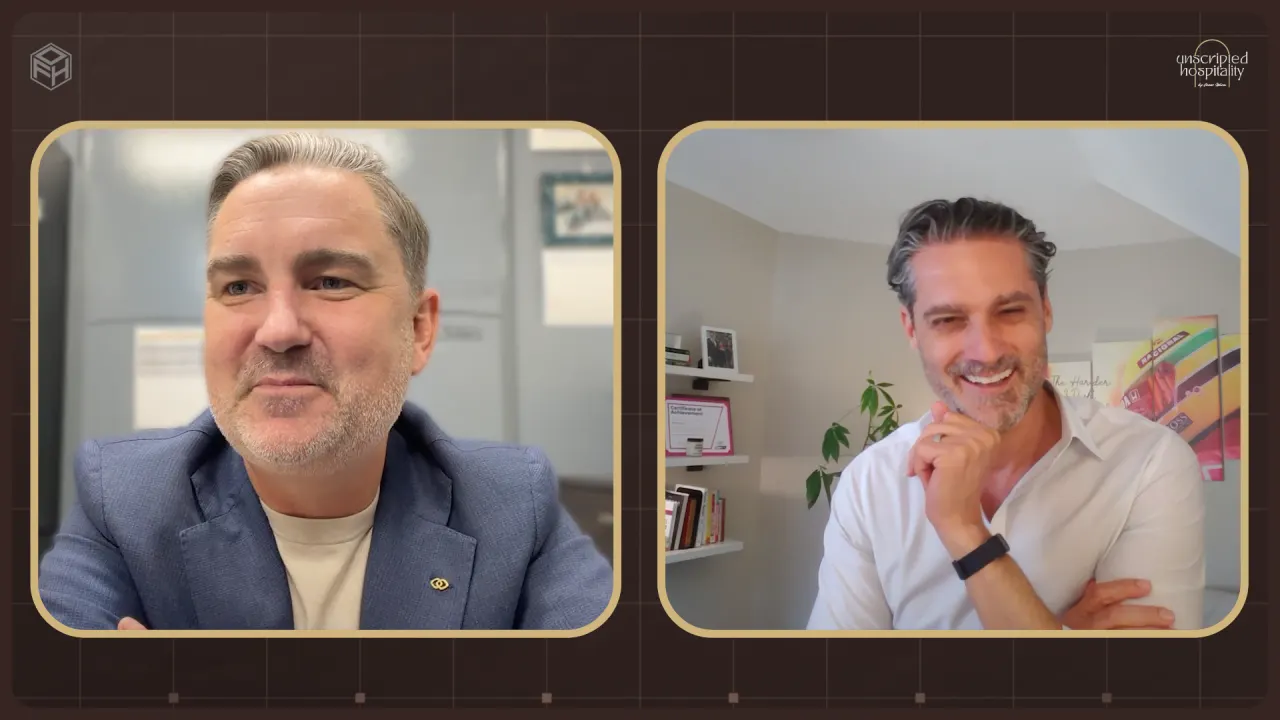
the Future of HospitalityHi, everyone. Welcome to the future of hospitality. My name is Caesar, and I have a pleasure today to welcome a, you know, a dear friend, and someone that I truly admire besides a person, you know, as a leader, Patrick Goddard, CEO of the BrightLine
Patrick Goddardin in Florida. Welcome, Patrick. Thanks, Cesar. Great to be here with you, man. Likewise.
the Future of HospitalityLikewise. I was when I first saw you come to the screen, I was thinking, how come I have all this gray and you have all, like, this
Patrick GoddardSo I really am unsure, although they're starting to show up in my beard Yeah. And disappear back here. But, you know, so far, I haven't, you know, I haven't I haven't shown as as much my age as as others have. I don't know what it is. So some of you are in maybe. Whatever whatever you're doing, keep doing.
the Future of HospitalityYeah. And, Patrick, no. Thank you again. Really honored when when you said yes because we've known each other now for over ten years. And I remember More. Yeah.
Patrick GoddardI mean, I think we were at trust I finished in 2016. Yeah. Less than 2016. I've been here now for nine years. So we worked together for a few years before then, and, you know, we started talking a little bit before that. So it's been a long time we've known each other. Yeah. Yeah. And you're someone that I always admired.
the Future of HospitalityYou know, of course, as a person, you you have an amazing heart. And but I was always in awe as I joined you at trust for those that who don't know you, and they can speak to it, but you were a partner, right, and used to run, you know, as the COO. And I reported into you, and I remember being in meetings with you and just really in awe about your ability to, you know, quickly bring things together, the ability to lead people and navigate very difficult situations with such class and peace and something so easy about watching you do that, that was like so inspiring.
the Future of HospitalityI don't know if if you can relate to that. Hopefully, you see that. But, I don't know. Like, what do you think has led to be kind of who you are today?
Patrick GoddardLook. Everybody's got a story, I suppose. And mine, you know, started in Ireland and and I was educated born and educated there. And and, I I don't know exactly. I think part of it is independence. I think very early on, I had a lot of independence in life. It was just the environment that I grew up in. My parents were extremely you know, I I don't know whether I would call them, like, extremely open or just irresponsible. I'm not sure which, but, I definitely got left to my own devices probably more often than I was supposed to, which led to lots of trouble but lots of learnings.
Patrick GoddardAnd I think that I always grew up with a sense of ownership of my own life and, you know, a desire to make things work independent of others. So it was a mindset that got developed very early on that I then translated into my professional life. And and whether that whether I was working as a waiter or, like, washing windows when I was a teenager for my neighbors or, you know, like, any endeavor that I that I took on, I took ownership of it. And I I always felt like I was responsible. I always felt that I was the guy responsible. And I and I never, you know, relied on anybody else to solve my problems for me.
Patrick GoddardSo I think that that end up getting a lot of practice to solving problems. And then I think you you you recognize that, like, whether they're big problems or little problems, either things that are in your control or outside of your control. You know? I don't wanna wax too philosophical with you, and and maybe we can do that later. I'm not sure if that's that if it's that kind of podcast, but I can wax philosophical. But I think that having that experience of of of understanding that there are certain things that I can control here, there's certain things that I can't. And and I and I think that I recognize that early in my life, and that was a real gift because it helped me to you know, I've always been pretty good about regulating my emotions around difficult situations and difficult decisions.
05:00Patricks frühes Leben und seine Führungshaltung
14
Patrick erzählt von seiner Kindheit in Irland, früher Selbstständigkeit und wie diese seinen Stil beim Lösen von Problemen und in der Führung prägte.
Patrick GoddardSo I can get animated about things, and I do. And I I am very passionate about what I'm doing, so I can get animated about things. But I tend not to panic. And, you know, I I do think that, you know, there's an extent to which even today, there are things in in my world here at BrightLine that I can control. There's things that I cannot. And and, you know, we're going through unprecedented growth right now, but we've got lots of pressures, outside pressures, and some of it makes it into the media. And it can be a big distraction for some people. And, like, you know, the conversation I have even with my own team recently is you gotta focus on what's in front of you and what you can control every day, and and that's sort of been my philosophy around around life.
Patrick GoddardI also think it's important that you are passionate about and care about what you're doing. And because I think when you don't, that leads to lots of problems. Mhmm. People can see that. People can see through that when you don't really care about what you're doing. And we all know those leaders who didn't care about what they were doing. You can see them from a mile away. Yeah. So I've never wanted to be somewhere where I didn't believe in what I was doing. So that's contributed to a to a two. At Trust, you know, as you know, we started off with basically nothing, and we grew it to a 50 hotel portfolio.
Patrick GoddardWe were in 10 countries, 20 different markets. All four and five star independent hotels, you know, New York, Florida, The Caribbean, Central America, South America, Mexico. Yeah. And that was my dream job. Like, when I was a teenager coming up in hotels you know, thinking about going to hotel school, went to hotel school, you know, my dream was to fly around and build hotels. Yeah. And I got to do that for, you know, almost ten years. And so it was my dream job. So whatever the issue was that we were dealing with, like, that's the journey. That's that's the fun part. Like, the end is cool, and the accolades and awards and the recognition, that's all cool. But the fun was sitting with you and the rest of the team and figuring this stuff out and making it work, you know, for the, like like, whatever, the 70 room resort in The Bahamas or the, you know, 30 room resort in Cartagena or wherever we were doing stuff. Like and and it was very unique because we had all these different markets we were in, and and we had different challenges to solve and different labor practices and different qualities of people.
Patrick GoddardI remember in Honduras when we did that project literally running classes on on how like, teaching people how to like, basic grooming. And Yeah. You know? So so those are all unique challenges that we got faced with in that in that in that company that like, I just that was the that was the fun part. That's when I was in maximum flow, and I'm working with all of you and with our owners and our teams on the ground to make things happen. So that's all fun to me.
the Future of HospitalityYeah. Yeah. You it showed it shows. So, yeah, I I have very fond memories as well to your point. And I'll have a we had a small but mighty team that we went and did a lot, and I learned so much, in that journey. Yeah. It was it was a lot.
Patrick GoddardScrappy, but not crappy.
the Future of HospitalityYeah. There you go. Scrap, but not crappy. Yeah. I'll use that one. Yeah. And then, you know, as we're talking earlier, okay, so congrats on nine years there. That's amazing. And I can't imagine the I can't imagine the journey because I I think for a couple of things. Right? I think one, would love to hear how was transitioning from, you know, the hotel side to delivering hospitality and leading train a development, right, at the time you're developing that with your team there and really from scratch that I don't know how long ago was the last time anyone has done that in The US, right, Amtrak. I don't know how long ago, but you're you're basically, you know, a maverick kind of doing that. And then and then how do you bring hospitality?
the Future of HospitalityBecause I experienced, BrightLine, and you and your team do an amazing job. You know, what could be a very boring and unmemorable experience, you know, is always very well spoken from anyone that have, you know, heard that that experience your services. So can you talk a little bit about that and how, I don't know, all that you've seen and learned the last nine years that I can imagine, you know, that must be a lot. So
Patrick GoddardI'm gonna get some tips from you because I need to write a book about all of this. And and I I now know that you're an author. Yes. So I'm gonna talk to you and our other friend, Steve Turk. I'm gonna get some guidance on on how to write my book. Yeah. But there's a there was a lot, and it was an incredibly enriching experience. And and I don't think that there has been any challenge that I have had had up until that point that was as intellectually diverse as what I've had to do for the last nine years. And, you know, starting with, like, what attracted me to it, and and I think this is I think the hospitality industry and and having experience in hospitality is is superpower in in today's world because that's where everything is going to, experience economy.
Patrick GoddardAnd it's how do you take things that have traditionally been considered commodities and turn them into experiences? And you can apply it to student housing. You can apply it to health care. You can apply it to basically anything. Even in retail where people are selling literal commodities, they're trying to turn those retail, centers into experiences. There's a reason for that because that's what people gravitate towards. It's about how you make people feel. So when I got the call about BrightLine, it was actually crazy because, as you know, I hadn't worked for anybody for about a decade. I actually didn't even have a resume. So when I got a call from a recruiter by by the way, it was total serendipity for a million reasons. So somebody was, like, looking out for me because I was in the process of exiting trust, and there was a negotiation that was underway at that time about kind of where I was gonna end up and how I was gonna gonna be treated.
Patrick GoddardAnd all as all of that was happening, I get a phone call from a recruiter. And I I'm telling you, nobody had called me in ten years. Nobody had called me for a job. I don't know whether I just I just seemed that seemed like I was really happy, or or people just I I don't know. But it's kind of strange when you're in some of these certain roles. People don't think to approach you. They just don't think you're available. And maybe I'd kinda given off those signals when people had kind of mentioned things casual to me. But but, anyway anyway, I digress. The point is I hadn't heard from anybody in a long time, and I didn't even have a resume. And they called me, they're like, hey. We've got this thing that we're doing. And I remember talking to my wife, and my wife is a very, how can I describe her? She has feelings about things, let's just say. I don't I'm not gonna say she's a witch, but, you know what I'm saying. And she's like, I have a good feeling about this for you. And, when she says that, I listen.
Patrick GoddardSo I put together my resume, and I really intended just to interview to have leverage in my negotiations. And then I got offered the job. And I went back and tried to use my leverage, it didn't work. So I ended up taking the job, and I actually initially thought it was gonna be a soft landing until I figured out my next hotel thing. I'm like, okay. Whatever. I'll do this for a while until I figure out my next hotel thing. And little by little, I got more like, I went further down the rabbit hole. But what was it what the what what what made this exciting and compelling for me was this opportunity to take the commodity of transportation and turn it into an experience. It was an opportunity to leverage my fifteen, twenty years of hospitality experience and translate it into a train. And and you're right. Nobody has done a private intercity passenger rail system in America for over a hundred and twenty five years. Henry Flagler was the last guy to do it.
Patrick GoddardSo it doesn't exist. The only other intercity passenger rail operator in The United States is Amtrak. So this is the first of its kind ever in over a hundred and twenty five years. So this and and it's it's a it's a big project. It's a high profile project. It's a $6,000,000,000 investment in the state of Florida, which, by the way, is gonna feel really, really cheap when I tell you how much it's gonna cost to build BrightLine West between LA and Vegas and, you know, other projects. 6,000,000,000 is feels like a bargain. But at, you know, at that time, it was, like, massive. It's massive. It's a massive investment.
Patrick GoddardAnd you're you're talking about a system that runs 235 miles between Miami and Orlando with five train stations in South Florida, and, you know, manufacturing 10 trains and building designing and building the stations. And here in Miami, we built, if anyone's ever been to Miami Central where our station is in Miami, we built a million square feet of real estate here. 850 apartments, 300,000 feet of office, a 130,000 feet of retail, and we integrated the whole facility with all of the transit, systems in South Florida. So Metro Mover, Metro Rail, Tri Rail all come into this station with BrightLine. So it was a massive undertaking.
15:30Vom Hotel zu den Brightline-Zügen
17
Gespräch über den Wechsel von der Gastfreundschaft zur Leitung von Brightline und die Schaffung eines einzigartigen Personenbahn-Erlebnisses in den USA.
Patrick GoddardBut the opportunity to do what I had done in hospitality and translate it to BrightLine was what excited me about this the most. And I had always in the back of my mind, you know, alright. I fulfilled this dream of flying around the world and building hotels, and maybe it needs to be over for me. Even though I didn't feel like it, you know, it was time, and maybe that's the way it always happens. You never quite feel like you're done. You never quite feel like you're ready to move to the next thing, but then the next thing presents itself. And you have to make a decision. You have to make the leap. So I made the leap. I kind of was pushed, but, you know, I made the leap.
Patrick GoddardYou know? And once I really embraced it and I said, well, wow, this is an opportunity to take all of that experience and translate it into BrightLine and build a transportation system where architecture is important, interior design is important, customer service is important, the digital experience, which is a massive learning curve for me, was important. And and and, you know, customer service, food and beverage, quality food and beverage, all of those things that I had done before, how do I translate that into a train station, into a train system? And that's what we did. So I joined in 2016. We launched Miami to West Palm Beach in 2018, and then we launched Orlando in 2023. And, it's been going for about two years. We're carrying about 300,000 people a month, and we're growing every month, we're growing 20% year over year. And Wow. We just received thirty thirty more coaches. So we we're increasing our capacity by about 50% over the next two months Wow. Because a third of our trains have actually been sold out. So we've actually had to artificially constrain demand because we just haven't had the capacity. So October 6, actually, we're launching a new schedule where our trains are going to get a lot longer, and that's a massive unlock for us and really what pushes us from sort of, you know, from where we have been for the last year. It's gonna accelerate that growth, in a really meaningful way, which we're all, of course, very excited about seeing happen.
the Future of HospitalityYeah. Wow. That is interesting. I I mean, I knew about the, you know, the demand. And and it's interesting. What what have you seen from you know, because in The US, you know, you you come from Europe where a train is super basic and how most people commute is is so natural. But in The US, it's all about cars. Right? We gotta drive everywhere. So have you seen a shift on,
Patrick Goddardyou know, attracting loyal kind of riders? How how was that? Was that a hard sell? Or, you know, how speak to that a little bit. At the start, it definitely was. I mean, you were literally, like, prying their white knuckled hands off the steering wheel and dragging them into the station for the first time. So it took some time, definitely. This is a very car centric culture in The US in general, but particularly in Florida. You know, in Miami, like anywhere to anywhere, it takes forty five minutes. In Central Florida, nothing is close by either. So you've you you know, these are markets where everyone is dependent on a car. So trying to get that modal shift has definitely been a challenge.
Patrick GoddardBut in spite of that, you know, we have since we launched Orlando, and I'm just gonna talk about we talk about our business in terms of the short haul and the long haul. Short haul is Miami to West Palm and then I think in between. Long haul is anything that goes up to Orlando or comes from Orlando down to South Florida. And it's really all about like, 80% of the revenue is long haul. So that's what we focus on for the most part. Although short haul is a great incubator for long haul passengers, it's really about the long the revenue is all in the long haul tickets because, you know, a ticket from Fort Lauderdale to Miami is, like, 20 to $30. A ticket from Miami to Orlando is, like, 80 to $120.
Patrick GoddardSo, obviously, a big difference there. So you wanna if you're gonna sell a seat, you're you you you would prefer somebody going to Orlando than going to Fort Lauderdale or going to Aventura or something. Right? So where we are today is we we we we basically have this very and, again, with our capacity constraints, we've consistently brought 50 to 70,000 new customers into the system every single month since we launched. And those were hard won, and, you know, our marketing plan and budget has evolved over time. But as you can imagine, at the beginning, it was all about creating awareness. And you had lots of billboards and TV and, like, very kind of broad marketing efforts to get people aware that we existed.
Patrick GoddardBut then you've got to transition them from that to, like, actually getting on the train for the first time, and that was hard. And we did that through, you know I mean, we hit everybody. So we we had a combination of direct sales. We, you know, performance marketing, sweepstakes, social, competitions, community events, you name it. We've we've done everything you could imagine to try and, you know, convert people from, yes. I know there's a train that exists to, I'm gonna try it for the first time. And you have to help them overcome all these hurdles on, like, how do I get to the station, and how do I get from the station to my final destination? And is there gonna be a train to bring me back from where I'm going to? And can I afford it? And how much is parking? And, you know, what's the seat like? And is there Wi Fi? And can I get food? And you know? So there's a lot of hurdles to overcome. So trying to figure out how to fashion your marketing and communications, in a way that's gonna resonate with your target customer is hard because there's a million use cases for using the train.
Patrick GoddardIt's just about getting that use case in front of that person so they go, oh, alright. Now I know why this might work for me. You know, I'm a student at UCF. I'm a business traveler, and this is gonna help you be more productive. And and a lot of people at the outset focused on travel time, you know, travel time and cost. And they're like, okay. Is it gonna cost me more money than driving, and is it gonna save me any time? So so, that was hard to over because the travel time between Miami and Orlando on our train is about three hours. Most Miami and Orlando people think they can drive from Miami to Orlando in three hours.
Patrick GoddardNow you can do that if it's three in the morning and you're driving at 90 miles an hour, but you can't do that normally. It's more like four to six hours depending on how many times you stop and how bad traffic and weather is. But in people's brains, they were like, well, that's not much of a time savings, and then I still gotta figure out how to get to my destination. But over time, once you got them on for the first time, they were like, oh, this is great. Like, can be productive. I can have a cocktail. I can walk to the bathroom. My kids are occupied, and they can do stuff, and we're not all piled into a car together. I don't have to stop to pee.
Patrick GoddardYou know, I can watch a Netflix movie. I can catch up on my whatever series. There's Wi Fi. There's chargers. There's food and beverage on board. And then I think, you know, for people getting to the station in Orlando, they they started to understand that there was a very well established transportation network from the Orlando Airport to Disney, Universal, SeaWorld, I Drive, etcetera. So, you know, once they did it for the first time, they were sold. And, you know, we're very proud of our trains run about 95% on time, which is unheard of in the rail industry. Like, you talk to any international operator, no one's running at, you know, above 90%, a. B, we've got a our our net promoter score is about 75, which is on par with, like, Ritz Carlton and Four Seasons. Everybody loves the product.
Patrick GoddardThey love the product. They're only mad if they, you know, whatever, they got delayed or Yeah. You know, whatever. But for the most part, you know, people love the product, and they love the experience. And that's what we doubled down on. And they were very smart, you know, like, to think about it through that lens and to recognize that it wasn't gonna be enough to just provide the commodity of transportation. You had to build an experience around it in order to overcome the difference between train travel and car travel. It had to be better. It had to be a better experience than being in your car, and that's what we've focused on trying to deliver here. And I think we've done a fairly good job of it. You know, we got two classes of service, smart and premium. So, you know, like, again, I talk to our our our our guests all the time, and we're constantly soliciting feedback from them and editing and refining the the offerings and the service. But I think we've we've got a really, really good product. And, you know, about half of our ridership is is are still new people, but half of our ridership is repeat.
Patrick GoddardWow. So that used to be, like, more, like, 70% new, 30% repeat, and now it's becoming more, like, 40% new, 60% repeat. So and the repeat kind of continues to grow exponentially because you've got you know? Again, the more the more people you bring into the database, the more they repeat, the, you know, the there's exponential growth there in in those total numbers. So repeat starting to very quickly outpace new. New is very steady. Repeat's like going up into the right. And we really haven't even touched the domestic and international markets very much because we haven't been on the GDS. We're about to go live on Amadeus in about three weeks' time.
Patrick GoddardIf you talk to any of the international rail operators, they're all on GDS, and about 15% of their business or 20% of their business, and in some cases more, are third party. We're 96% direct to consumer web and app, which, like, if you're a hotel, like, that's amazing. But, you know, you're probably not hitting 70% occupancy with 97% direct to consumer. You know, you're probably struggling because, you know, you need that distribution. You need that because I can't spend marketing dollars in Sao Paulo. I can't spend marketing dollars in Bogota. I can't spend marketing dollars in New York City. I've gotta rely on travel distributors to to get me those customers. So that's going to be so the capacity additions coming up and access to the GDS coming up opens up interline agreements with airlines. We just announced our first one with JetBlue, opens up all the high volume travel sellers. It opens up all the TMCs. Right? So the the corporate travel travel management companies, we haven't been able to access them at all because they all wanna work through the GDS. A few of them have got APIs, but they mostly wanna work through GDS. So the Amex travels and the Concurs and the BCD travel and Carson Wagonley, they they're like, let us know when you're connected to GDS, and we'll be happy to talk to you. So we're gonna be getting to the point where we'll be able to add that additional distribution towards the end of this year right in time for the World Cup teams announcements, in December.
Patrick GoddardSo I'm really excited about that too.
the Future of HospitalityThat's amazing. Yeah. That's gonna be a game changer for for you. And and you're on the the board, or are you in some Man, I'm on the I'm on the host committee board for FIFA. Board. Yeah. So the host committee, every
Patrick Goddardcity that has a has games has to part of the deal when you solicit, you know, from FIFA to have a game in your market, you've got to set up a host committee, and that host committee has to fund a bunch of, like, fan activities and so on and so forth. So,
the Future of HospitalityI'm part of that host committee. Yeah. Well, they have a smart guy there. So, yeah, thanks for serving there. Good. I know we're we're coming on time, but I still have two two great questions that I wanna too much. I'm sorry. No. No. No. No. This is great. It's it's really good. Two questions. First one, you know, leading you as you described your journey, you had very different positions, you know, and amazing successful run on different industries. What is something from a leadership that you can share, you know, for anyone that's already well established or an upcoming, you know, someone that used to be us, you know, twenty years ago or whatever that you see that is is applicable regardless of what you do in life, you know, at your work?
28:00Herausforderungen bei der Akzeptanz von Zügen in den USA
13
Einblicke in den Wandel einer autozentrierten Kultur, Marketingstrategien und den Aufbau von Kundentreue für Brightline.
Patrick GoddardSo I think that so it's a very broad question, but I'll do my best. I think that I have relied on, number one, white belt mentality. So when I came into this position, I didn't know anything about trains. And being prepared to readily admit that you don't know anything about trains when you're surrounded by people who've been in trains for their whole lives and having the sort of humility and self awareness to acknowledge that and to be curious and vulnerable about learning. I think that a lot of people think that they have to be smarter than everybody around them, and that is couldn't be further from the truth.
Patrick GoddardYou need to be curious, and you need to be open. And our policy here forever, including today, is no one's done this before. There is no blueprint. So you you know, telling me that this is what you did in your last place has very little value. That's just like one data point. It's not it doesn't become the rule for us. We have to figure out what's right for us, and we have to develop our own hypothesis about how things are going to work. And then we're gonna test that hypothesis, And it's either gonna work or it's not gonna work, and then we're gonna edit, modify, and refine, and try something else.
Patrick GoddardAnd this has been a ten year experiment, know, experiment after experiment after experiment of trying things, breaking things, changing things. Some of those things were disruptive. Some of those things were less disruptive. Some of those things made things worse. Some of these things made things better. But being open to that and having this white belt belt mentality when you walk into that, particularly when you change an Like, you're not expected to have all of the answers, so don't pretend that you do. I also think that it is really important as a as a leader to look for people, particularly in a new field, and I'm gonna give you just sort of my context. Like, this was a new this was a pioneering effort.
Patrick GoddardSo you evolve rapidly, and you change things a lot. And you're not gonna make it through that unless you have surrounded yourself with people who score high on resilience and adaptability. So the two qualities that I would look for in terms of people to surround myself with are people who have got a high degree of resilience and adaptability, and that's what I'm looking for when I'm interviewing folks here at BrightLine. And just generally, trust too. We evolved and changed all the time. We were growing rapidly. There was a lot happening. We go into new markets. We, you know, we change rules, change policies, change how we were doing things. So if you've got people who are are are not flexible, they break.
Patrick GoddardIt's really that simple. So I I think looking for people to to surround yourself. And then finally, like, I think it's really important to understand what your own values are. And I think everybody should spend some time understanding, you know, their own identity and what they value and what's important to them. And then when you are searching for your next opportunity, making sure that your values and their values align. And that's not just about the company's values, but it's also whoever your leader is going to be. Because if you're not aligned in terms of values, you know, at some point, that's going to break. And because you're you're either gonna feel uncomfortable because you're being asked to do things that don't align with your values or vice versa. You're gonna be asked to you know? So I think too few people in leadership positions. You know, they're climbing the corporate ladder. They're hustling and working hard and trying to make it. And for all the right reasons, usually, right, they wanna they wanna be able to be independent. They wanna make money. They wanna advance themselves. They wanna improve their lifestyle. They wanna, you know, help help build a legacy for themselves and and and, you know, sustain their families and so on. But you can't lose sight of your values when you're doing that, because that's how you get lost. And that's how you become trapped too, by the way. You get trapped in a shitty job for the money.
Patrick GoddardYou then build a lifestyle around the money as opposed to a lifestyle around your values, and then you can't get out of it. You know? You've now trapped yourself in this lifestyle, for the money. You know? You've built your life around the money and not around your values, and I think that that is, a recipe for disaster, and I've seen it many, many times where I talk to peers. And they are so far gone that there is no turning back. You know? And that's what leads to people being dis you know, dissatisfied, disgruntled, having marital problems, you know, on and on and on. It creates a lot of problems. So I think spending the time, whether you do it on yourself with the help of some books or whatever, or you work with a therapist or you, you know, work with a friend, figuring out, like, who am I? What do I care about? What's important to me? What are the values that I have for myself?
Patrick GoddardAnd and how do I make sure that those align with the work that I'm doing? Because if they don't, it is a recipe for disaster.
the Future of HospitalityWow. Wow. That's that's golden right there. Big one. I'm sure everyone's gonna take notice. It's so true. I wrote it down here for myself. It's like, you know, that was powerful. Build her life around her values. And and I had a lot of this self discovery, this journey you're describing, right, through my sobriety journey because, to your point, because I was suppressing so much, and I was not, you know, kind of being true to myself, to my values. And to your point, it spirals out of control and can be quickly, and, it is hard. Right? It is hard, to to get out of that. So amazing, share. Thank you.
the Future of HospitalityOkay. So fast forward ten, twenty years from now, you know, if you're there or not there. But as people think about BrightLine, you know, what would you like them to think or be said about it?
Patrick GoddardI'd like them to say that we brought intercity passenger rail back to America. And, and and I'd like the evidence of that to be a thriving Florida system, a thriving LA to Vegas system, and five or six other corridors around The United States where where we've built a system like this. And and I think, you know, as we as we would as we progress, we'll just make it better and better. You know, the project in out west is gonna be electrified, high speed, 200 mile an hour rail, whereas our top speed here in Florida is a 125 miles an hour. It'd be 200 miles an hour. So you'll be, like you'll have four trains pass you as you're sitting on I 15 and traffic between LA and Vegas, not wondering why you're not on the train. So that's what I think that's what I would love to see happen with BrightLine. I think that it's a I think it's an incredible product, and I think it needs to be all over the country. And, I really hope that what we've created here in Florida is the blueprint for that.
the Future of HospitalityAmazing. Amazing. Thank you. You know, Patrick, thank you, man. Really appreciate the opportunity to talk. It gives makes my my heart feel of joy just kind of reliving, you know, having this conversation with you. And and, you know, you're someone that really has had impact to many people that I know. And, you know, thank you for being this amazing person, this amazing leader, and, always lifting others, right, and bringing them along the way. So, yeah, I can't wait to see,
Patrick Goddardyou know, continue to grow, continue to experience BrightLine, and see all the amazing things that are to come. Well, I'm very proud of you, Cesar, and all of all that you've you've you've come out the other side of a a difficult situation, you know, and and you're now making such a positive impact with the work that you are doing. So I every time I see a post from you, or anything that you produce, I feel the same way. My my heart's full of joy. I'm, I'm very proud of you, and, I I hope to see you continue doing that amazing work that you're doing.
the Future of HospitalityYes, sir. Will do. Will do. Thanks again. Alright, brother. Thank you. Really appreciate it.